What Standards Should Childcare Centre Cleaning Meet for Hygiene?
Childcare services in Australia deal with constant touch points, shared toys, and bodies that are still building immunity. That’s why childcare centre cleaning has to meet clear hygiene standards, not just look tidy. The right approach reduces illness spread, supports compliance, and helps families feel confident about care.
What does “good hygiene” mean in an Australian childcare setting?
Good hygiene means cleaning and disinfecting in a way that reduces germs to safe levels, especially on high touch surfaces and in nappy change and food areas. In practice, childcare centre cleaning should follow documented routines, use suitable products, and be consistent across rooms, days, and staff shifts.
It also means separating “cleaning” from “disinfecting” so the service is not relying on a single wipe for everything.
Which Australian rules and guidance should childcare services follow?
They should align their hygiene practices with their state or territory public health advice, plus the National Quality Framework expectations around health and safety. Many services also use national infection control resources as the backbone of their procedures.
Even when exact wording differs between jurisdictions, the expectation is the same: childcare centre cleaning must be planned, repeatable, and verified, not improvised.
What is the difference between cleaning, sanitising, and disinfecting?
Cleaning removes visible dirt and reduces germs by using detergent and water. Sanitising lowers germs to a safer level and is often used for food contact surfaces. Disinfecting uses a chemical to kill germs on a surface after it is cleaned.
For childcare centre cleaning, this distinction matters because disinfectant is less effective on dirty surfaces, and overusing disinfectant where it is not required can create unnecessary chemical exposure.
What areas must be treated as highest risk every day?
Highest risk zones are nappy change areas, toilets, handwashing sinks, kitchens and food prep benches, and any surface contaminated with bodily fluids. High touch points like door handles, light switches, cot rails, taps, play tables, and shared devices also need frequent attention.
A strong childcare centre cleaning plan prioritises risk based on how germs spread, not on what looks messy.
How often should cleaning and disinfection happen during operating hours?
They should clean high touch points multiple times a day, and immediately when visibly soiled. Toilets, nappy change surfaces, and hand basins generally need more frequent attention because contamination is expected.
Many services build a simple schedule: open, mid morning, after lunch, mid afternoon, and close, with extra spot cleaning as needed. This keeps childcare centre cleaning consistent without relying on memory.
What standards apply to bathrooms, toilets, and nappy change stations?
These areas should be cleaned with detergent first, then disinfected with a product suitable for the surface and the germ risk. They should also manage cross contamination by using separate cloths or disposable wipes and dedicated buckets or colour coded systems.
For childcare centre cleaning, the nappy change mat and surrounding bench edges are crucial, as are taps, flush buttons, and door latches.
What hygiene standards apply to kitchens and food preparation areas?
Food areas should use a food safe approach: clean, rinse if required by the product, then sanitise. Dishwashing should use hot water and detergent, and items must be fully air dried before storage.
In childcare centre cleaning, it is important they treat lunch boxes, bottle warmers, highchair trays, and benchtops as food contact surfaces rather than general furniture.
How should toys, books, and learning resources be cleaned safely?
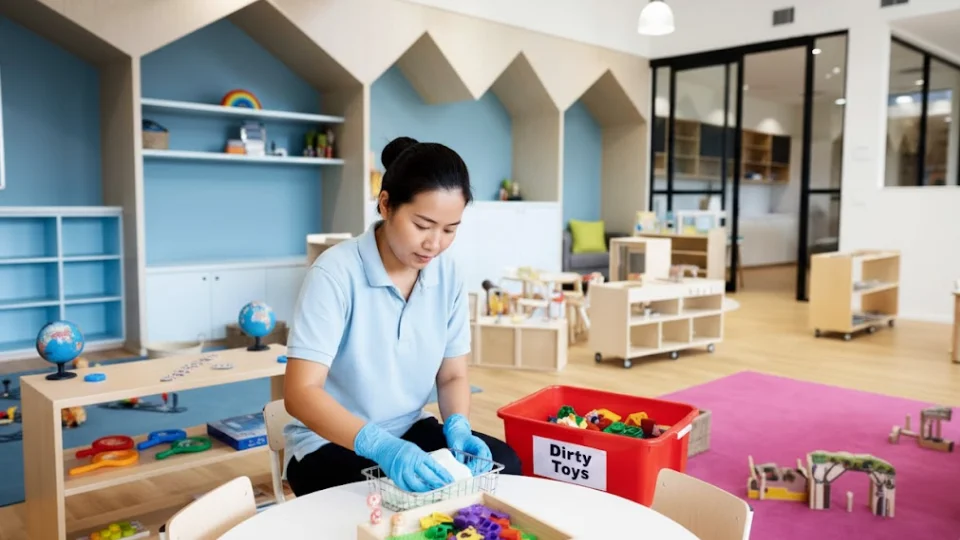
They should group toys by material. Hard plastic toys can be washed with detergent and warm water and disinfected when needed, then fully dried. Soft toys should be laundered regularly and removed immediately if mouthed or visibly dirty.
Books and wooden items need gentler methods to avoid damage, but still require regular cleaning of high touch covers and surfaces. A practical childcare centre cleaning system includes a rotating toy cleaning roster so nothing is missed.
What standards should apply to bedding, cots, and sleep rooms?
They should wash linens regularly and immediately when soiled. Cots and sleep mats should be cleaned between children when shared, focusing on rails, edges, and contact points.
Ventilation also matters in sleep rooms. Childcare centre cleaning is not only about surfaces, since stale air and humidity can increase odours and discomfort, and can worsen respiratory symptoms for some children.
How should services handle bodily fluids like vomit, blood, and diarrhoea?
They should isolate the area, use gloves and appropriate PPE, remove bulk contamination with disposable materials, then clean with detergent and apply a disinfectant suitable for bodily fluids. Waste must be double bagged and disposed of safely, and staff should perform hand hygiene immediately after.
For childcare centre cleaning, incident response checklists help ensure no step is skipped during stressful moments.
What chemicals and disinfectants are appropriate for childcare environments?
They should use products that are fit for purpose, used exactly as labelled, and safe for the surface and the setting. Contact time matters, so wiping a disinfectant straight off can make it ineffective.
They should also store chemicals securely, never decant into unlabelled bottles, and avoid strong fragrances that can irritate children. Good childcare centre cleaning uses the mildest effective option for the task.
How should cleaning tools and equipment be managed to prevent cross contamination?
They should separate tools by area, such as toilets versus rooms and kitchens. Cloths and mops should be laundered or replaced frequently, and buckets should be emptied, rinsed, and dried after use.
Vacuum cleaners should have maintained filters, and brooms should not be used in ways that spread dust. A reliable childcare centre cleaning program treats tools as potential carriers of germs, not just helpers.
What role does hand hygiene play alongside cleaning standards?
Hand hygiene is one of the strongest controls against illness, even with excellent surface routines. They should ensure sinks are accessible, soap and paper towel supplies are maintained, and educators model proper handwashing.
Childcare centre cleaning supports hand hygiene by keeping taps, basins, and dispensers clean and functional, and by reducing contamination on shared surfaces that hands touch all day.
How can a centre prove their cleaning meets hygiene expectations?
They can document schedules, checklists, product Safety Data Sheets, staff training, and records of incidents and deep cleans. They can also use spot checks, supervisor sign offs, and periodic internal audits.
For childcare centre cleaning, evidence matters because it shows the service is proactive, consistent, and accountable, especially during outbreaks or when families ask what processes are in place.
See Also : What Car Dealership Cleaners Do Differently for Showroom Floors
What should be included in a daily, weekly, and monthly cleaning schedule?
Daily tasks should cover high touch points, bathrooms, nappy change areas, floors in high traffic rooms, and waste removal. Weekly tasks often include deeper toy rotations, detailed kitchen attention, vents, and storage areas. Monthly tasks can include high dusting, grout checks, and curtain or mat laundering depending on usage.
A layered schedule helps childcare centre cleaning remain thorough without overloading staff on a single shift.
When is a deeper clean needed beyond the routine schedule?
They may need a deeper clean during gastro or flu outbreaks, after a confirmed infectious illness, after building works, flooding, or pest issues, or when odours persist despite routine care. Seasonal spikes in illness can also justify increased frequency on touch points.
In childcare centre cleaning, deeper cleans should be planned and recorded so the response is structured, not reactive.
Should centres use professional cleaners, and what standards should they expect?
They can use in house staff, external contractors, or a mix. If they engage professionals, they should expect clear scopes, child safe chemical use, consistent attendance, and reporting, including any missed tasks or hazards found onsite.
Professional childcare centre cleaning should integrate with educator routines, not clash with nap times, meals, or drop off and pick up flows.
How do Australian weather and local conditions affect cleaning standards?
Hot, humid weather can increase mould risk and odours, while winter can drive higher respiratory illness transmission. Coastal locations may see salt residue and faster wear on surfaces, and dusty inland areas may need more frequent floor and air intake cleaning.
Childcare centre cleaning should adapt to local conditions across Australia, rather than using a one size fits all schedule. Check out more about Preventing the spread of respiratory viruses.
What are the biggest mistakes services make with hygiene and cleaning?
Common mistakes include skipping detergent cleaning before disinfecting, using the wrong product for the surface, reusing the same cloth across rooms, and relying on “looks clean” as a standard. Another issue is unclear responsibility, where everyone assumes someone else cleaned it.
Childcare centre cleaning works best when roles are assigned, checklists are signed, and supplies are always stocked.
What does “best practice” look like for families choosing a centre?
Best practice is visible and explainable. They should be able to describe how they clean toys, how they manage illness outbreaks, what products they use, and how they keep bathrooms and kitchens safe. The environment should smell neutral, sinks should be stocked, and schedules should be consistent.
Strong childcare centre cleaning reassures families because it is systematic, not performative.
What is the simplest hygiene benchmark a centre can aim for every day?
They should aim for consistent removal of dirt, frequent high touch cleaning, correct disinfection only where needed, and solid hand hygiene support. If those four are reliable, illness risk drops and compliance becomes easier to demonstrate.
When childcare centre cleaning is routine, documented, and matched to risk, the service is far more likely to maintain hygiene standards year round.